





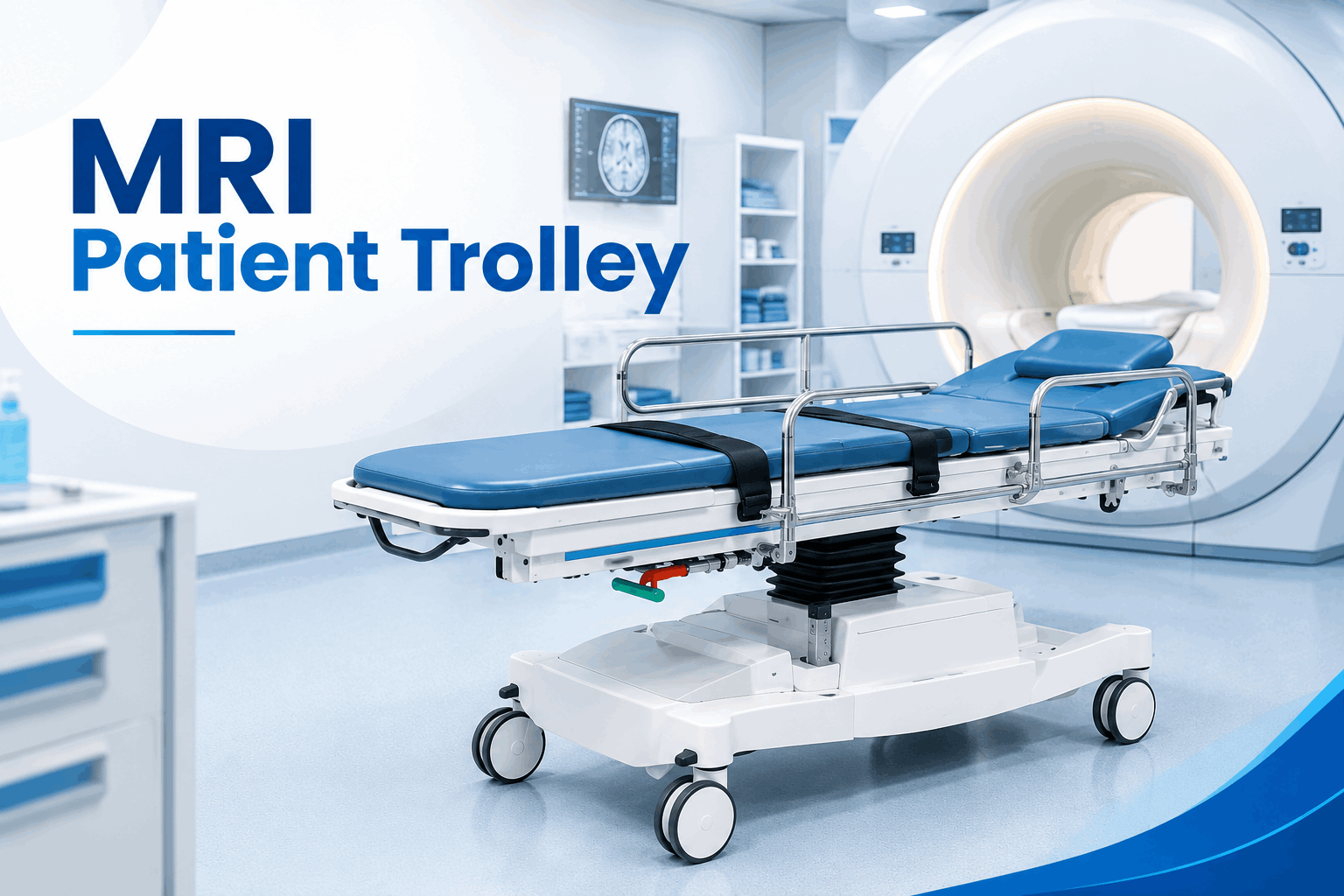
MRI Patient Trolley for Efficient Imaging Department Workflows
An MRI examination can involve patients with very different clinical needs. Some may walk independently, while others may arrive from an inpatient ward, emergency department, surgical unit, or specialist clinic and require assisted transportation.
A suitable MRI Patient trolley can help healthcare teams organise patient movement between clinical areas and the imaging department. For NHS Trusts and private healthcare providers, the value of appropriate transport equipment extends beyond convenience. It can contribute to smoother coordination, better patient positioning, and a more structured imaging workflow.
Aayan Medical Imaging Limited supports healthcare organisations throughout the United Kingdom with medical equipment solutions for modern clinical environments.
The Importance of Structured Patient Movement
An imaging appointment involves more than the scan itself. Patients need to arrive at the correct location, be prepared appropriately, transferred safely, positioned for imaging, and returned to the relevant clinical area.
When patients have mobility limitations, these stages can require additional planning.
A dedicated patient trolley can provide a consistent method of transportation between relevant points within the department, helping staff coordinate transfers according to the patient’s individual circumstances.
Patients Who May Need Assisted Transport
MRI departments treat a broad range of patients. A trolley may be particularly useful for individuals who cannot comfortably or safely walk for the duration of the transfer.
This can include patients experiencing:
- Temporary mobility limitations
- Fatigue or physical weakness
- Reduced ability to stand
- Pain during movement
- Recovery following medical procedures
- Age-related mobility challenges
- General clinical instability
The appropriate method of transfer should always be determined by trained healthcare professionals according to the patient’s condition.
Improving Workflow Between Departments
Hospital imaging services frequently coordinate with multiple departments. A patient may need to travel from a ward to radiology and then return after the examination.
Equipment that fits into the department’s operational process can help staff manage these movements more consistently.
Supporting Scheduled Appointments
For planned MRI appointments, predictable patient movement can contribute to smoother scheduling. Suitable transportation equipment can help staff prepare patients and move them through the imaging pathway without unnecessary handling changes.
Managing Inpatient Imaging
Inpatient MRI examinations may involve coordination between ward staff and imaging teams. A suitable trolley can provide a practical transport option when a patient is unable to use standard walking routes independently.
Supporting Return Transfers
Once imaging is complete, patients may need to return to their ward, treatment area, or recovery location. Consistent transport equipment can support the continuation of the patient’s care pathway.
Patient Comfort During Transportation
Clinical safety is essential, but patient experience should also be considered.
Patients attending MRI may already feel anxious because of their medical condition or the unfamiliar imaging environment. Comfortable and controlled transportation can make the journey to and from the examination less stressful.
A trolley should provide suitable support for the intended patient group, while staff should make adjustments according to individual needs.
The design should also allow trained personnel to maintain appropriate control during movement through the healthcare environment.
What Procurement Teams Should Evaluate
When purchasing an MRI Patient trolley, healthcare organisations should assess the equipment against their own clinical workflow.
Dimensions and Access
The trolley needs to work within the physical layout of the department. Doorways, corridors, preparation rooms, scanner access areas, and storage locations should all be considered.
Patient Capacity
The selected model should be appropriate for the expected patient population and operational requirements. Procurement teams should check manufacturer specifications rather than relying on assumptions.
Ease of Handling
A trolley that can be managed effectively by trained personnel can support practical movement between different areas. Manoeuvrability becomes particularly relevant where departments have restricted spaces or multiple transfer points.
Cleaning and Maintenance
Equipment used for patient transportation needs to fit within existing infection-control and maintenance processes. Healthcare providers should review how easily the equipment can be cleaned and maintained as part of routine use.
Integrating a Trolley Into Clinical Practice
A trolley should not be viewed as an isolated piece of equipment. Its effectiveness depends on how it fits into the wider patient-handling process.
Staff training, transfer procedures, MRI department protocols, patient assessment, and equipment checks all contribute to safe use.
Before introducing new equipment, healthcare organisations can review where the trolley will be used, who will operate it, how patients will be transferred, and where it will be stored when not required.
This approach can help ensure the equipment supports rather than complicates the existing workflow.
Medical Equipment Support Across the UK
For NHS Trusts and private healthcare providers, medical equipment procurement often requires attention to clinical requirements, operational practicality, and long-term usability.
Aayan Medical Imaging Limited provides medical equipment support to healthcare providers across the United Kingdom, helping organisations identify equipment suited to their intended clinical applications.
A properly selected MRI Patient trolley can support a more organised patient journey from arrival through imaging and onward transfer. However, healthcare teams should always confirm that the selected equipment is appropriate for the intended MRI environment and follow manufacturer and departmental guidance.
FAQs
What is an MRI patient trolley used for?
It is used to transport patients who require assisted movement during their journey to, from, or within an MRI imaging service.
Can it be used for all MRI patients?
Not necessarily. The need for a trolley depends on the patient’s mobility, clinical condition, transfer requirements, and the healthcare team’s assessment.
What factors matter when selecting a trolley?
Healthcare providers should consider dimensions, patient capacity, handling characteristics, cleaning requirements, storage, and suitability for the intended clinical environment.
Is patient comfort important during MRI transportation?
Yes. Patients may already be experiencing discomfort or anxiety. Appropriate support and careful handling can help make transportation more manageable.
Support a More Organised MRI Patient Journey
Efficient patient transportation is an important part of delivering well-coordinated imaging services. The right equipment can help healthcare teams manage transfers while keeping patient needs at the centre of the process.
If your NHS Trust or private healthcare organisation is reviewing patient transportation equipment, contact Aayan Medical Imaging Limited to discuss suitable medical equipment solutions for your clinical environment across the UK.
